Upper Back Pain Relief: Why the Ache Between Your Shoulder Blades Won't Go Away
Upper back pain relief starts with understanding why the standard approach keeps falling short. Upper back pain ranks among the most common complaints among desk workers and active adults, and many people handle it the same way: stretch, apply heat, feel better for a day, then wake up tight again. The cycle repeats because that approach treats the symptom while leaving the source intact.
Persistent tension between the shoulder blades often has a deeper layer driving it. That layer is fascia, the web of connective tissue that surrounds every muscle, bone, and organ in the body. When fascia becomes restricted, it creates a pulling sensation that feels just like a tight muscle but won't release with standard stretching alone. Body Unlocked in Henderson is a myofascial release practice built around addressing this connective tissue layer directly, rather than managing surface symptoms.
This guide covers the full picture: immediate relief tactics, effective stretches, stabilizing exercises, ergonomic fixes, and a clear explanation of when home remedies aren't enough.
Why upper back pain keeps coming back
The usual suspects: posture, strain, and repetitive stress
The most common triggers for thoracic back pain are familiar ones: prolonged sitting, rounded shoulders, repetitive one-sided motion, and accumulated screen time. These patterns overload the upper trapezius, rhomboids, and mid-back muscles, creating a near-constant state of tension. The result is that dull ache between the shoulder blades that returns every time you stop paying attention to how you're sitting.
The connective tissue layer most treatments miss
Fascia wraps every structure in your body. When it becomes restricted, it pulls in ways that feel exactly like a tight muscle but don't release with stretching alone. That distinction matters: you can stretch daily and still wake up stiff because the fascial tension driving the problem hasn't been directly addressed. Myofascial restrictions produce a mechanically blocked sensation and sometimes referred pain patterns that general muscle soreness simply does not.
Why the pain keeps cycling back
Without addressing that connective tissue layer, most upper back pain relief strategies treat the symptom rather than the source. Stretching and strengthening still matter, you'll find both in this guide. They work better and last longer when fascial restrictions aren't constantly pulling tissue back into dysfunction. The familiar pattern of temporary relief followed by a return of tension is almost always a sign that something beneath the muscle layer remains untouched.
Immediate upper back pain relief: what to do in the first 24, 48 hours
1. Heat vs. ice: the quick answer
For the typical scenario of chronic stiffness and posture-related mid-back ache, heat is the right choice. Apply for 15 minutes with a cloth barrier between the heat source and your skin. Reserve ice for a new, acute strain with swelling or sharp onset; in that case, use cold in the first 24 to 72 hours. For everything else, heat wins.
2. OTC pain relief: using it safely and briefly
Ibuprofen and naproxen sodium often work best when inflammation is the main driver. Acetaminophen is usually the better option if you have stomach sensitivity or take blood thinners. Always consult your pharmacist or clinician if you're on prescription medications, especially anticoagulants, and be sure to speak to your doctor before beginning any OTC medicines. Treat either as a short-term bridge: if you're still reaching for pain medication after 10 days, a deeper evaluation is warranted rather than another refill.
3. A quick mobility reset you can do right now
Stand, interlace your hands behind your head, and gently arch your upper back while keeping your neck neutral. Follow with five slow shoulder rolls back and down. This takes under a minute, delivers a brief thoracic extension the spine rarely gets during screen time, and can be repeated throughout the day between tasks. It's not a full stretch routine; it's a reset that prevents the tissue from locking in one position for hours at a stretch.
Upper back pain relief stretches for thoracic tension
4. Cat-cow and thoracic extension over a foam roller
Start on all fours with hands under shoulders and knees under hips. Alternate between arching your back (belly drops, head lifts) and rounding it fully, 10 slow reps. Follow with thoracic extension over a foam roller: sit on the floor with the roller behind you, lie back so it supports your upper back, and cradle your head with your hands while you breathe into the extension for 5 to 10 short holds. This is one of the most effective moves for mid-back pain relief because it takes the thoracic vertebrae through extension, a range of motion that prolonged sitting rarely provides.
5. Thread-the-needle for thoracic rotation
Start in tabletop position on hands and knees. Reach one arm up toward the ceiling, then slide it underneath your body, lowering that shoulder toward the floor as your upper back rotates. Do 5 to 10 reps per side, moving slowly and letting the motion come from the ribcage rather than forcing it. This stretch directly addresses the rotational restriction that accumulates from hours of forward-facing screen work. Most people feel it right away in the area between the shoulder blades, making it a reliable shoulder blade pain remedy to keep in regular rotation.
6. Doorway chest stretch and seated thoracic twist
Place your forearms on a door frame with elbows at 90 degrees and lean forward gently until you feel the stretch across your chest and front of the shoulders. Hold 10 seconds and repeat three times. Add a seated thoracic twist at your desk: sit tall and rotate your rib cage slowly 10 reps in each direction. Together, these two moves address both the front-of-chest tightness and the rotational stiffness that feed posture-related pain between the shoulder blades.
Strengthening moves to stabilize your shoulder blades
7. Face pulls and wall angels
Anchor a resistance band above eye level, hold the handles with an overhand grip, and pull toward your face while flaring your elbows out and squeezing your shoulder blades together at the end of each rep. Do 3 sets of 12. Wall angels are the bodyweight complement: stand with your back flat against a wall, arms bent to 90 degrees, and move them up and down like a slow snow angel while keeping contact with the wall. Three sets of 10. Both movements train the rhomboids, middle and lower trapezius, and rear deltoids, the muscles that directly counteract the forward pull of prolonged sitting and provide lasting upper back pain relief by building structural support.
8. Prone scapular work (W, T, and Y raises)
Lie face down on a mat and move your arms into a W shape, squeezing the shoulder blades together without shrugging. Hold briefly, release, and then repeat in a Y position with arms angled forward. Do 3 sets of 10 reps for each position. The goal is activating the lower and mid trapezius, which are chronically underused in desk workers and rarely recruited during standard stretching. This is not about range of motion; it's about waking up the stabilizing muscles that take load off the thoracic spine during everyday movement.
Desk setup and posture habits that stop pain from returning
9. The five workstation adjustments that matter most for relief for upper middle back pain
Set your monitor so the top of the screen sits at eye level. Keep your keyboard and mouse close enough that your elbows stay near 90 degrees and your shoulders remain relaxed. Use lumbar support to maintain your spine's natural curve and prevent rounding through the upper back. Keep both feet flat on the floor, with a footrest if needed. Set armrests so they support your arms without lifting your shoulders. These five adjustments work together to keep your head, shoulders, and arms in a neutral position, removing the mechanical load that drives posture-related back pain day after day.
Movement breaks: the habit that compounds over time
Brief movement every 30 to 60 minutes does more for posture-related upper back pain than any single stretch session. Stand, do a quick thoracic extension, roll your shoulders back, and get back to work. Two minutes between tasks, done consistently, accumulates more benefit than a single long stretch session ever could. No single "perfect posture" prevents back pain, but frequent posture variation compounds in your favor over weeks in a way that one long weekend stretch session simply cannot replicate.
When home remedies aren't enough: red flags and root-cause care
10. Knowing when to stop treating this at home
Some symptoms require medical evaluation, not more stretching. Seek care immediately if your upper back pain comes with any of the following:
- Chest pain or pressure, or shortness of breath
- Fever, chills, or unexplained weight loss
- Numbness, tingling, or weakness in your arms or legs
- Loss of bladder or bowel control
- Balance problems or difficulty walking
- Severe pain that worsens despite home care, or pain following significant trauma
These symptoms can indicate causes that go well beyond muscle tension, including spinal infection, fracture, or cardiac and aortic issues. Don't wait on them.
Why persistent tension may be a fascial problem
If pain between your shoulder blades keeps returning despite doing everything right, the issue is likely deeper than muscle tightness. Fascial restrictions don't release on their own and don't fully respond to stretching alone. For some people, myofascial-focused therapy becomes a worthwhile next step, one that targets the connective tissue layer that standard stretching and strengthening don't directly reach. As with any treatment approach, results vary, and it's worth discussing options with a clinician to find what fits your situation.
How a specialized MFR practice addresses the actual source
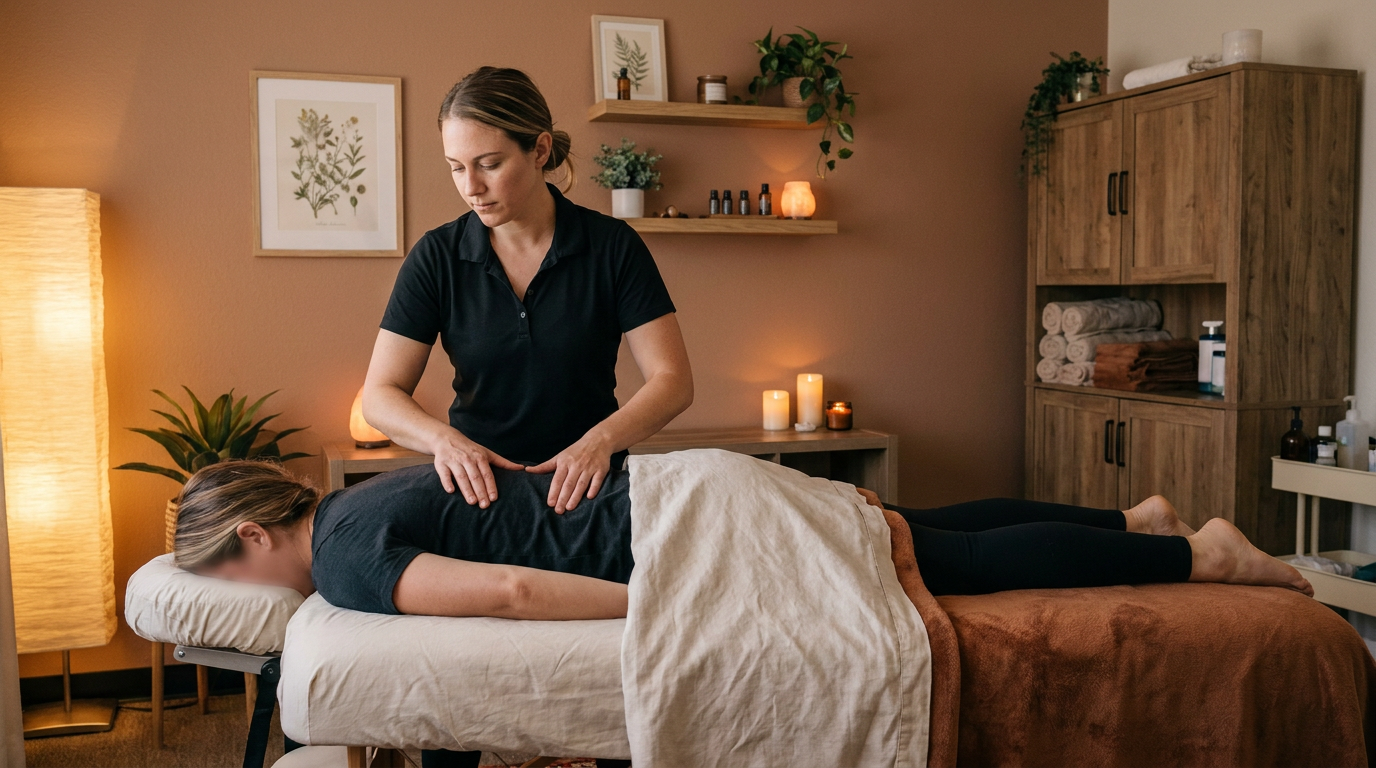
Myofascial release applies gentle, sustained pressure to specific fascial restrictions rather than working on general muscle relaxation. The treatment focuses on the connective tissue layer, releasing it at the source rather than managing symptoms at the surface. Body Unlocked in Henderson offers fully clothed myofascial release sessions, which removes a common barrier for first-time clients who aren't sure what to expect. The practice's focus is on the connective tissue layer specifically, an approach worth exploring for upper back pain that hasn't responded to standard home methods.
Your upper back can feel different than it does right now
Lasting upper back pain relief is achievable, but only when you address the full picture. The ten methods in this guide work across different layers: immediate symptom relief, tissue mobility, structural strength, and ergonomic prevention. Many people see meaningful improvement by applying the stretches, strengthening moves, and desk adjustments here with real consistency.
For those who have worked through all of this and still wake up tight every morning, the missing piece is often the fascial layer. That's not a failure of effort; it's a signal that the connective tissue driving the tension hasn't been addressed directly. Finding a practitioner who works specifically with that layer, rather than treating it as an afterthought, is a meaningful next step worth considering.
The pain you're experiencing right now is real, but it's not permanent. Understanding what is actually driving the tension is where lasting upper back pain relief begins.
About the Author
Dr. Jeff Keysar, DC, is the owner and lead practitioner at Body Unlocked in Henderson, NV. With 27 years of experience as a chiropractor, Dr. Keysar has performed Myofascial Release (MFR) on thousands of patients and brings advanced training in spinal biomechanics and engineering-based spinal rehabilitation to every session. He specializes in helping clients with chronic pain conditions who've hit a plateau with traditional therapies like PT, chiropractic care, and massage find lasting relief. Learn more on the Meet Dr. Keysar page at bodyunlockedlv.com.
Myofascial Release Articles